Visa heads into its fiscal fourth-quarter report on October 27 with one of the cleanest operating track records in large-cap financials — and a share price that doesn't quite reflect it. The stock trades roughly 6–7% below its 52-week high even after three consecutive earnings beats, including fiscal Q3 adjusted EPS of $3.32 (a 2.8% surprise, up 11% year over year), a 6.8% surprise in fiscal Q2, and a narrower 0.9% beat in fiscal Q1.
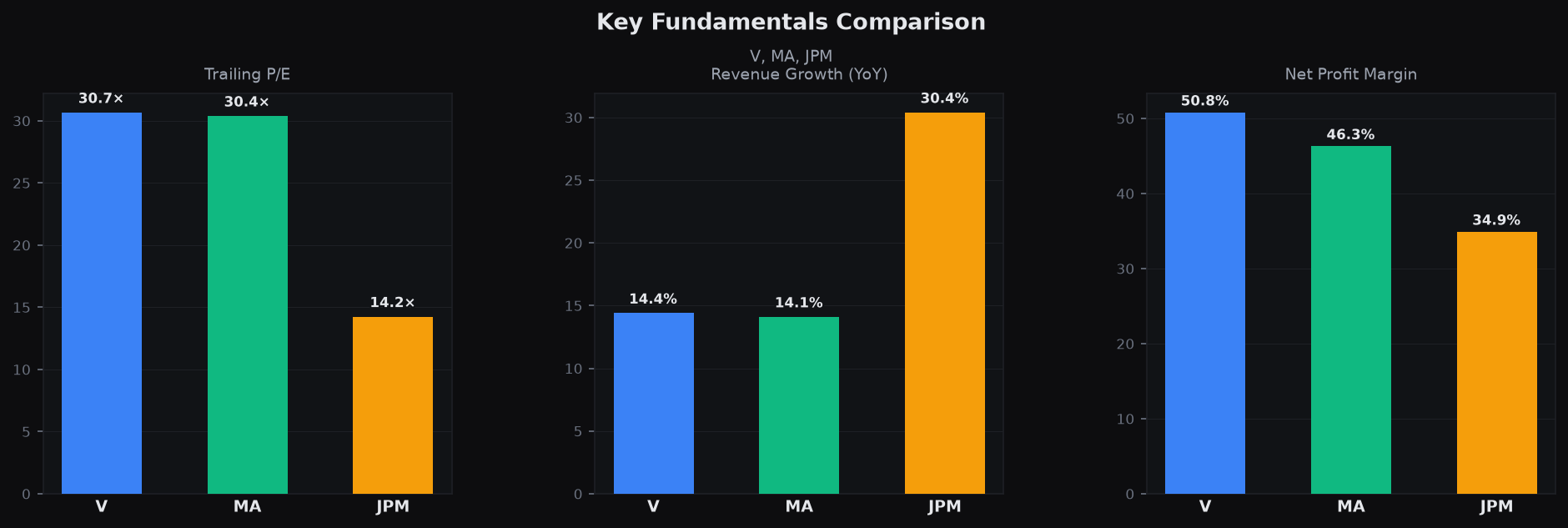
Consensus for the upcoming quarter sits near $3.43 in adjusted EPS (analyst estimate), with full-year fiscal 2026 estimates clustered around $13.23 (analyst estimate). The tension is straightforward: Visa's operating model is firing on all cylinders, while the external environment — a Department of Justice antitrust suit, interchange rate caps, decelerating domestic volumes, and a macro data blackout — keeps a lid on the multiple.
The Fundamental Case: Margins That Don't Exist Elsewhere
Visa's financial profile is genuinely unusual, even among asset-light compounders. The company reports a 97.7% gross margin, a ~51% net margin, and a 61% return on equity. Those are confirmed figures, not estimates, and they describe a business that collects a toll on global commerce without underwriting credit risk or carrying meaningful cost of goods.
The comparison that puts this in perspective: JPMorgan, one of the best-run banks in the world, operates at roughly a 40% net margin. Visa earns more than half of every revenue dollar as net income, with none of the balance-sheet exposure that forces banks to hold capital against downturns. That structural difference is why Visa is classified in financials but rarely behaves like one.
Management has been returning that cash aggressively. In April 2026, Visa raised its quarterly dividend to $0.67 per share and authorized a new $20 billion buyback. The announcement landed alongside the fiscal Q2 beat and drove a 5.2% single-day gain — a rare move for a mega-cap and a clear signal of internal confidence.
The Mastercard Read-Through Investors Should Study First
If you want a preview of what October 27 might look like, start with Mastercard. Its Q2 2026 report beat by 5.5% with EPS of $5.04, but the headline number buried the more important detail: U.S. switched volume growth decelerated from roughly 8% to around 5% across recent quarters.
Meanwhile, cross-border volume held up at approximately 12%, supported by travel and FX activity. That split — soft domestic, resilient international — is the single most valuable forward-looking tell available ahead of Visa's print.
If Visa's disclosures mirror that pattern, the interpretation matters enormously. A similar domestic deceleration alongside healthy cross-border growth would suggest an industry-wide normalization in U.S. consumer spending, not a Visa-specific share loss. That is a far more benign read. But it would still raise questions about the durability of double-digit revenue growth into fiscal 2027, particularly if management's guidance language turns cautious. JPMorgan's recent 4% drop on CFO expense commentary — despite a strong EPS quarter — is a reminder that forward tone can override backward results.
The Legal Overhang: DOJ and Interchange
The bear case rests primarily on litigation. The DOJ filed suit in roughly May 2026, alleging Sherman Act Section 1 and Section 2 violations tied to monopolization of the U.S. debit market. Legal-press estimates place roughly $7 billion of debit revenue in scope — a figure that has not been confirmed by Visa.
The case is in discovery and will almost certainly turn on market definition. The DOJ wants a narrow framing: card networks competing for debit routing. Visa will argue for a broad one that includes cash, ACH, and fintech rails, under which its share looks far less dominant. That argument will take years to resolve, which means this is a persistent valuation discount rather than an imminent catalyst.
Separately, the long-running interchange settlement received court approval in 2026, with a second merchant distribution in September 2026 and new interchange rate caps effective since April 2026. That removes legacy legal uncertainty but structurally caps take-rate economics going forward. The caps are already embedded in guidance — the question is whether they compress further over time.
The Next Frontier: Stablecoins and Agentic Commerce
Visa launched its VSP/OUSD stablecoin platform in July 2026, roughly ahead of Mastercard's June 2026 stablecoin settlement rollout, which followed Visa's comparable launch by about two months. Mastercard has since closed its BVNK acquisition in Q3 2026, buying infrastructure rather than building it.
On agentic payments, Visa Intelligent Commerce is positioned for mainstream adoption by late 2026, with Mastercard pursuing parallel protocols. Visa holds a genuine first-mover edge in both verticals — but neither network's stablecoin economics are material yet. Treat this as optionality, not an earnings driver. Any monetization detail on the October 27 call would be new information.
Macro Backdrop and the Technical Setup
Financials have been lagging — the sector finished among the weakest performers in a recent session (+0.06%) while the S&P 500 gained 0.74%. The government shutdown has disrupted BLS jobs and inflation data, creating a visibility vacuum that elevates Visa's volume disclosures into a substitute consumer-health datapoint for the entire market.
Visa's 0.76 beta and bond-like duration characteristics cut both ways against an uncertain Fed path: higher-for-longer rates pressure the discount rate while potentially signaling consumer resilience.
Technically, the stock reads short-term oversold on hourly and daily timeframes while the weekly structure remains bullish on ADX and MACD — a classic pullback-within-uptrend configuration heading into a binary catalyst.
This article is for informational purposes only and does not constitute financial advice. Always conduct your own research before making investment decisions.