NVDA closed its fiscal Q2 FY2027 on August 26, 2026 with a print that would have been a blowout in any other era: $96.22 billion in revenue, roughly 5.7% above its own guidance, with Data Center revenue of $89 billion, up 117% year over year. Management then guided fiscal Q3 to approximately $108 billion — not just growth, but sequential acceleration off a base that is already the largest in semiconductor history. That makes four straight quarters of EPS beats, in a 3.5%–6.2% surprise range.
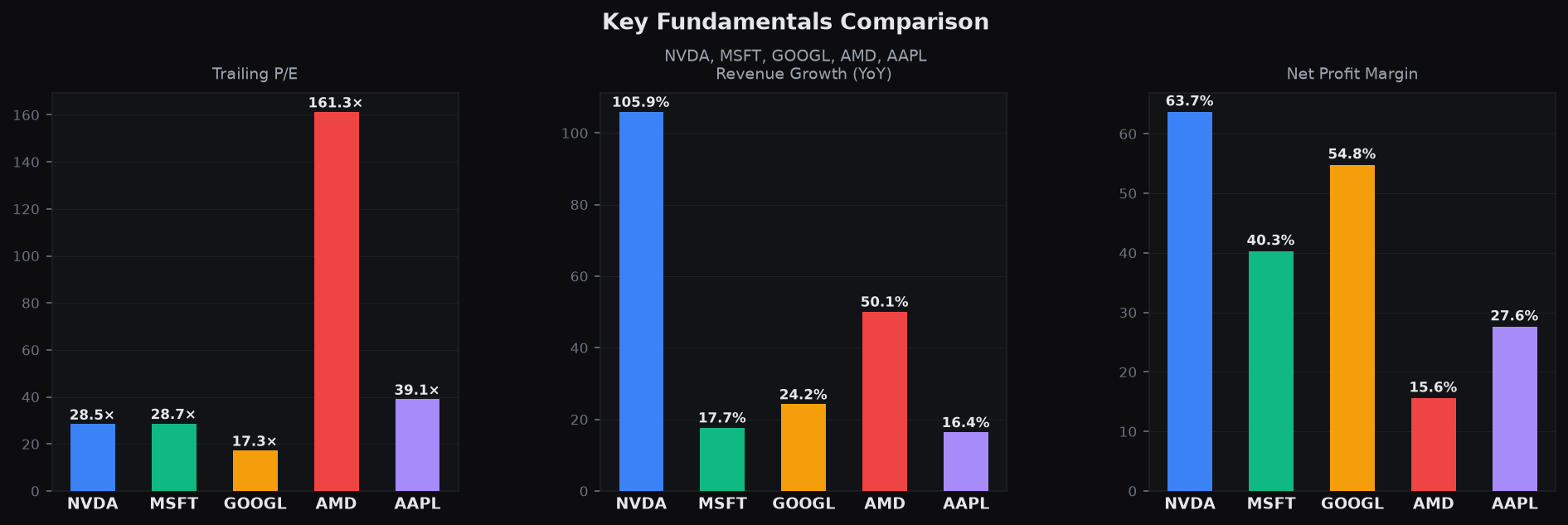
And yet the stock trades at a forward P/E of 14.35 against a trailing multiple of 28.49.
That spread is the whole argument. A forward multiple in the mid-teens on a company compounding Data Center revenue triple digits isn't a market that's euphoric — it's a market that has already underwritten the $108 billion guide and is now pricing the probability it doesn't extend. Compare that to peers: AAPL carries a forward P/E of 35.6x with a PEG of 2.7, and MSFT sits at 21.8x forward with a PEG of 1.62. Both are priced for perfection with far less growth torque. NVIDIA is priced for doubt. The question ahead of the November 17 Q3 report is whether that doubt is well-placed — and the most interesting evidence isn't in the income statement.
The Balance-Sheet Gap Nobody Has Explained
Here is the line item that deserves more attention than the revenue beat: NVIDIA's debt jumped from roughly $12.35 billion to $38.35 billion in a single quarter. That $26 billion swing flipped the company from a modest net cash position (+$0.43B in Q1 FY26) into net debt of approximately $15.9 billion.
For a business historically defined by cash generation, that's a structural change — and it is not clearly explained in current disclosures. The plausible candidates are supplier prepayments to lock in HBM and CoWoS capacity, pre-funding of foundry allocation, or some form of customer/partner financing, a pattern that has become increasingly common across the AI infrastructure complex. None of those are inherently alarming. But "NVIDIA is quietly financing its own demand chain" is a materially different investment story than "NVIDIA sells chips for cash."
Alongside it, net margin has compressed from a peak of roughly 71.5% (Q2 FY26) to about 62%. The likely driver is mix — more networking, more lower-margin China-compliant SKUs — rather than pricing pressure. It's not a red flag yet. It is something to track quarter over quarter, and the 10-Q is where you look for the footnote that explains both.
The China Gap: Permission Without Purchases
Policy and reality have split. The Trump administration has approved H200 exports to China, subject to testing, security review, and volume caps, and a Trump-Xi summit took place around September 24–25, 2026 (reporting on exact dates and venue has been inconsistent — treat as approximate). On paper, the door has opened.
But one report (Indy Finance, September 22, 2026) puts actual realized China chip sales at effectively zero despite the approval. If accurate, that's the single most important unresolved data point in the bull case, because it means the China reopening is currently worth optionality, not revenue.
Meanwhile, China's SAMR has a confirmed, active antitrust case tied to NVIDIA's 2020 Mellanox acquisition — an independent lever Beijing can pull regardless of how export diplomacy progresses. And the broader trade truce remains fragile, with rare earths, soybeans, and aircraft deliveries described by CNBC as inconsistently honored. Anyone modeling a China revenue restart should treat it as a call option, not a base case.
The Capex Supercycle Is the Demand Engine — and the Risk
Analyst estimates (Goldman Sachs and others) put 2026 hyperscaler capex at $700–785 billion, with 2027 approaching or exceeding $1 trillion. Stifel estimates MSFT alone trending toward ~$200 billion in FY2027 capex, alongside Alphabet's guided $195–205 billion and Amazon's ~$200 billion. That is NVIDIA's addressable demand, corroborated from the buyer side.
The tension: Microsoft's FY26 free cash flow declined to $66.99 billion from $71.61 billion despite 17.7% revenue growth, because capex nearly doubled to $115.95 billion. Sell-side is split — Goldman trimming targets while staying constructive, Stifel downgrading on Azure and capex-efficiency concerns. If the capex-to-revenue payback narrative sours, NVIDIA's largest customers have both the means and the incentive to moderate GPU spend. This is the sector's dominant two-way risk.
Customers Are Becoming Competitors
AWS Trainium3/4, Google TPU Ironwood/v8, Microsoft Maia 200, and Meta MTIA are all active or near-term. Inference now represents roughly two-thirds of AI compute spend, and inference is precisely where custom ASICs are most credible. GOOGL's July 2026 expansion with Marvell — including a roughly 59 million share warrant — signals hyperscalers hardening partner silicon strategies structurally, not opportunistically. AMD reportedly more than doubled in H1 2026; Intel rose sharply too. The market is pricing a multi-vendor future.
NVIDIA's answer is architectural: the Rubin platform (Vera Rubin NVL144 rack, unveiled at CES 2026) to extend the lead through H2 2026, with Rubin Ultra and Feynman sketched for 2028. Training remains NVIDIA's fortress. Inference share is the contested ground.
The Catalyst Calendar
Two dates resolve this. Late October hyperscaler earnings tell you whether capex guidance is holding or softening. November 17 tells you whether the $108 billion guide landed, what the debt line was for, and whether margins stabilized near 62%.
With a beta of 2.22 — the highest among mega-cap tech peers — and a complacent tape (VIX 14.87), NVDA offers real upside if both data points confirm. It also offers the sharpest drawdown profile in the group if either disappoints. Position sizing, not conviction, is the variable that matters most here.
This article is for informational purposes only and does not constitute financial advice. Always conduct your own research before making investment decisions.