Alphabet reports Q3 results on October 28, and the setup is unusually polarized. On one side: a fourth consecutive EPS beat, with Q2's print landing at $9.11 per share against roughly $2.90 consensus (a gap large enough that the magnitude likely reflects a reporting or split-adjustment quirk — treat the exact number cautiously until the 10-Q confirms it), and Google Cloud revenue growth re-accelerating to roughly 82% year-over-year. On the other: full-year capex guidance raised to $195–205 billion, and quarterly free cash flow flipping negative at -$5.86 billion as $44.9 billion of capital spending outran operating cash flow.
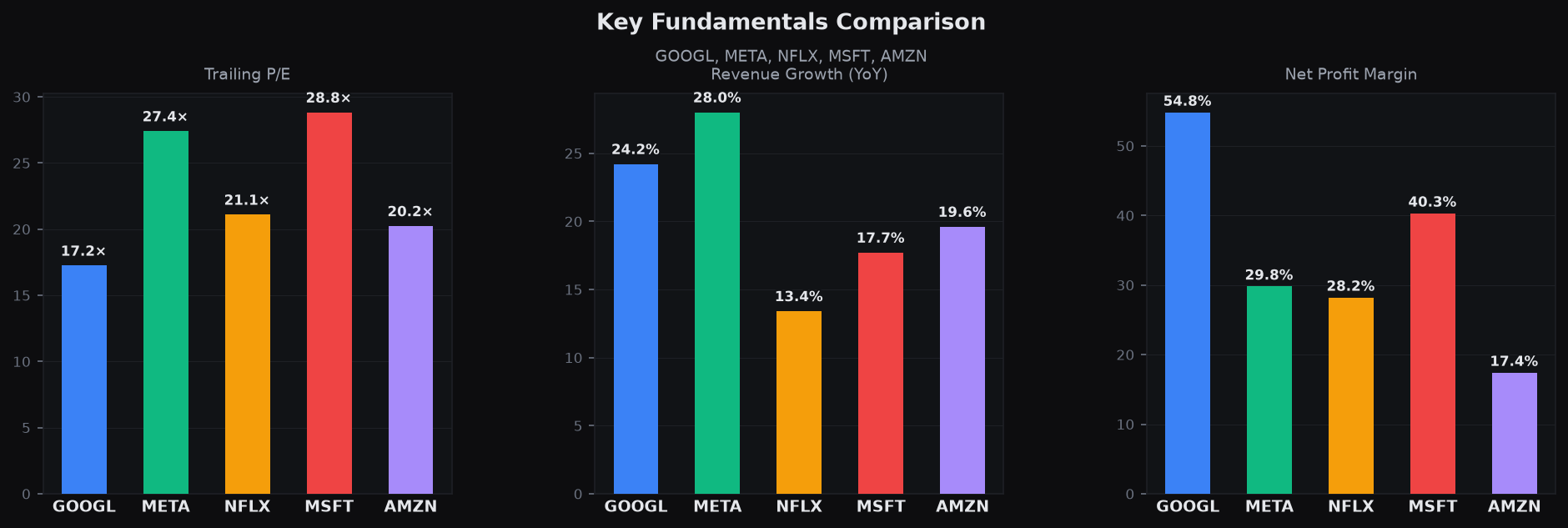
That's the whole AI trade compressed into one income statement. GOOGL is simultaneously the best demand-side evidence that AI infrastructure spending is working and the most dramatic example of what that spending does to cash generation.
The Bull Case: Demand Is Not the Problem
Google Cloud's growth trajectory is the single strongest fundamental data point across the mega-cap complex right now. Growth re-accelerated from roughly 63% year-over-year in Q1 2026 to approximately 82% in the most recent quarter — a figure sourced from independent analyst tracking (Tomasz Tunguz) rather than a direct Alphabet disclosure, though the trend is corroborated across multiple sources and is entirely consistent with why management raised capex in the first place. You don't add $15 billion to a spending plan because demand is softening.
Backing that up: Cloud remaining performance obligations (RPO, or contracted backlog) reportedly climbed to roughly $514 billion from about $460 billion quarter-over-quarter, with roughly half expected to convert to revenue within two years. Important caveat — this figure is analyst/secondary-sourced and has not been confirmed in Alphabet's own filings. Verify it on October 28 before building a thesis on it.
On the product side, Gemini 3 (November 2025) and Gemini 3.1 Pro with Workspace integration (March 2026) have driven reported Gemini app monthly active users to roughly 750 million as of Q4 2025 — again, aggregator-sourced and unverified against primary disclosures.
The most interesting corroboration comes from outside Alphabet entirely. The recent NFLX downgrade thesis from HSBC and Wells Fargo centers on YouTube eroding Netflix's share of viewing time to a multi-year low. When a competitor's sell-side downgrade names your asset as the cause, that's a cleaner read on YouTube's advertising moat than anything in an investor deck.
The Bear Case: The Cash Flow Math
The capex raise to $195–205 billion (up from $180–190 billion at Q1) is a confirmed company disclosure, and the market's response was immediate — roughly a 5% pullback around the announcement.
The deeper issue is what it did to free cash flow. Compare across peers: META saw FCF compress from $13.2 billion in Q1 2026 to $1.75 billion in Q2 — a brutal 87% drop, but still positive. Alphabet went negative. On this specific metric, GOOGL's spend is outrunning its cash generation faster than Meta's, and that matters because Alphabet has historically been valued as a cash-flow fortress.
Zoom out and the sector framing gets heavier. Combined hyperscaler capex across GOOGL, AMZN, MSFT, META and Oracle reportedly rose from roughly $271 billion trailing-twelve-months in April 2025 to about $482 billion in 2026, with 2026 sector-wide AI capex estimated near $600 billion. The "AI capex bubble" narrative intensified across financial media through September 2026, and Alphabet's raise is Exhibit A. With Meta reporting in the same week, the market may choose to re-rate spending discipline across the entire group at once.
The TPU Angle Nobody Is Pricing
Here's what makes Alphabet structurally different from its peers: it's the only hyperscaler positioning itself as an external AI chip supplier. The Anthropic TPU deal has reportedly been expanded, and — critically — reporting from the Meta side indicates Meta is evaluating Google silicon for its 2027 data centers. Neither side has formally confirmed a contract, so this remains a developing story rather than a bookable revenue line. But the cross-referencing from two independent directions raises the plausibility meaningfully.
If it materializes, Alphabet gains an NVDA-adjacent revenue stream that no other hyperscaler can replicate. Add Waymo — over 127 million cumulative rider-only miles across Phoenix, SF, LA and Austin, with funding talks reportedly near a $100 billion valuation on a $350 million-plus annual revenue run-rate (market reports, not Alphabet disclosures) — and the optionality stack is real.
The Regulatory Tail Risk
Alphabet carries the broadest multi-jurisdictional regulatory exposure in big tech. Judge Mehta's September 2025 remedies ruling avoided Chrome and Android divestiture but imposed default-contract and data-sharing restrictions; both DOJ/state AGs and Google filed appeals on April 13, 2026. In Europe, a €890 million DMA fine landed in July 2026 — Google's first — and a separately cited ad-tech penalty (~€2.95 billion, secondary-sourced) pushes cumulative EU liability past €10 billion.
These are durable multi-year overhangs, not October 28 catalysts. Price them as a persistent valuation discount, not an event.
The Verdict: Prove It
Three numbers decide the quarter. First, Cloud growth: does ~82% hold, or does it revert toward Q1's 63%? Second, backlog: does Alphabet confirm the ~$514 billion RPO figure in its own filings? Third, free cash flow: does it return to positive, or is -$5.86 billion the start of a trend?
Technically, the setup is mixed — a negative daily MACD cross with price below the EMA50, against a still-bullish weekly trend. The macro tape is supportive (VIX near 15, growth leading), which helps the multiple but won't rescue a disappointing cash flow line.
Bullish into 2027 requires Cloud growth above 70%, confirmed backlog expansion, and FCF turning positive. Bearish requires decelerating Cloud alongside a second negative FCF quarter — at which point the capex bubble debate stops being a narrative and starts being a valuation input.
This article is for informational purposes only and does not constitute financial advice. Always conduct your own research before making investment decisions.