The September 2026 Federal Reserve decision to raise the target range to 3.75%–4.00% was supposed to be bad news for technology. Higher discount rates compress the present value of distant cash flows, and no sector carries more distant cash flows than artificial intelligence. Yet the hike landed in the same month that hyperscaler AI capital expenditure estimates for 2026 firmed up around $730–803 billion — an estimated increase of roughly 78% year over year — with 2027 consensus now pointing above $1 trillion across the top four spenders.
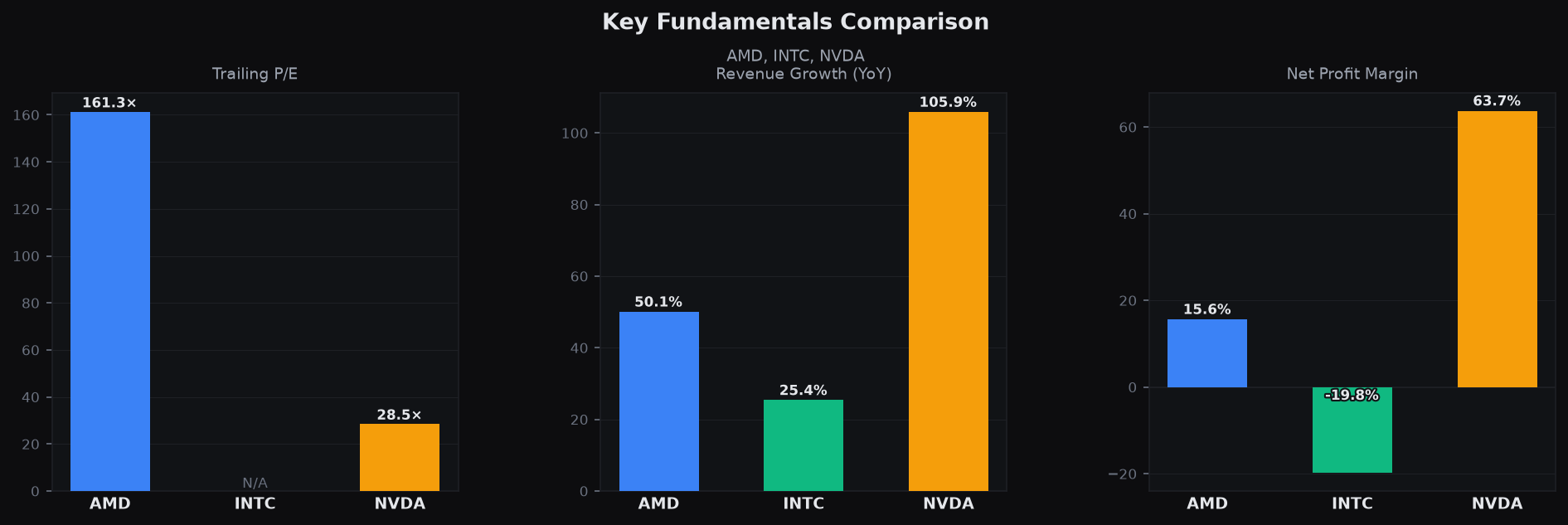
The result is a split screen. Instead of lifting or sinking tech as a bloc, the combination of tighter money and record capex has fractured the sector into two distinct trades: companies that sell compute infrastructure, and companies whose franchise economics are being disrupted by what that compute enables. 2026 is the year the AI trade stopped being a single monolithic bet.
AMD: The Re-Rating Nobody's Models Caught
AMD is the standout. The stock trades near $630 after a multi-year GPU supply agreement with OpenAI that carries reported incremental revenue potential above $100 billion. Structurally, the deal includes warrant tranches tied to AMD's own share price — the final tranche requires the stock to clear $600, a threshold that has now been crossed.
The unit math explains the enthusiasm. Analyst estimates put 2026 MI400 shipments at roughly 258,000 units at an average selling price near $30,926 — both estimates, not company-confirmed figures, but they imply a data-center revenue base that looks nothing like AMD's pre-2025 profile.
What's striking is how badly sell-side work has lagged. Barclays raised its target to $300 before the stock blew through that level, and a broader consensus target near $263 is now plainly stale. When price action outruns the analyst community by more than 100%, investors are effectively operating without a valuation anchor — a condition that cuts both ways.
Intel: From Distressed Asset to Momentum Trade
INTC at roughly $123 represents one of the more unusual re-ratings in recent market history. Two catalysts did the heavy lifting: a US government equity stake now valued at approximately $13–14 billion (Bloomberg-sourced), and a confirmed $5 billion Nvidia investment in May 2026 to co-develop data-center and PC chips fusing x86 with CUDA. That second announcement triggered a roughly 22% single-day surge.
Trailing 12-month performance figures range from about 174% to 481% depending on the source and measurement window — treat that range as approximate rather than precise. Either way, the narrative has completed a full rotation from balance-sheet concern to momentum vehicle, and the question analysts are now asking is uncomfortable: how much turnaround is already in the price? Intel's foundry execution remains unproven at scale. The stake and the partnership de-risk the story; they don't complete it.
Adobe: The Clearest Casualty
ADBE sits at roughly $235, down approximately 28% year to date — the sector's most visible laggard. The bear case is straightforward disintermediation: generative design and creative tools from OpenAI, Canva and Midjourney attacking the low and middle of Adobe's funnel, while Firefly monetization remains an open question.
Consensus has drifted to Hold across 24 analysts (as of 11 September 2026). Rothschild & Co Redburn maintains an outright Sell. Piper Sandler nudged its target from $240 to $250 — but kept a Neutral rating, which is the tell: even the incrementally more positive revisions aren't accompanied by conviction. A reported bull-case target near $314 implies roughly 33% upside, but that scenario requires evidence Adobe can convert AI from threat to attach-rate driver, and that evidence hasn't arrived.
Apple and Microsoft: Strong Fundamentals, Widening Disagreement
The middle of the sector is where dispersion tells the story. AAPL carries sell-side targets spanning $245 to $400 against a consensus near $328 — a spread of more than 60% between bull and bear. The overhangs are idiosyncratic: the Ternus CEO transition and unresolved questions about Apple's AI strategy and product roadmap.
MSFT shows a similar pattern, with targets running from Redburn's bearish $440 to $577–589 at the consensus and Stifel end. The debate centers on the capex-versus-free-cash-flow trade-off and Microsoft's OpenAI equity exposure. Notably, Redburn is cautious on both MSFT and ADBE — one desk applying consistent skepticism to the AI-software premium.
Three Structural Swing Factors
Custom silicon. Google TPU, Amazon Trainium, Microsoft Maia and Meta MTIA are estimated to compound at roughly 44.6% CAGR. The AI compute pie is expanding fast enough to absorb this, but it's a "bigger pie, smaller relative slice" dynamic that pressures NVDA and AMD inference economics over time. NVDA's consensus target near $327.70 implies roughly 46% upside on a Strong Buy rating — but that's a consensus formed before custom ASIC share shift becomes measurable.
Circular financing. The NVDA–OpenAI–AMD structures, where suppliers invest in customers who then commit to purchases, deserve scrutiny. They flatter near-term revenue visibility; they also concentrate counterparty risk.
China. The 24–25 September Trump-Xi summit produced rhetorical progress but no confirmed durable licensing resolution for NVDA and AMD China sales, while China's antitrust probe into NVIDIA remains open. This is the single largest unresolved variable in the sector.
This article is for informational purposes only and does not constitute financial advice. Always conduct your own research before making investment decisions.